If you are trying to work out your permanent impairment payout in Queensland, the first thing to understand is this: there is no single flat figure. The amount you receive depends on your:
That is why so many injured workers look for a WorkCover payout table or calculator. They want a straight answer: what does 5%, 10%, 15% or 20% DPI actually mean in dollars, and does accepting a lump sum affect anything else?
Our legal guide answers exactly that. We cover how QLD permanent impairment payout amounts are calculated, what the WorkCover payout table shows at each DPI level, how to use a payout calculator without being misled, and why the 20% threshold is the most important line in the entire process.
Key takeaways
This guide is general information about the Queensland permanent impairment process. It is not legal advice, and payout amounts depend on your own assessment and the rules in force when WorkCover makes your offer.
What you do after receiving a WorkCover lump sum determines what you can claim and how much compensation you receive. That’s why the QLD WorkCover website recommends seeking legal advice before starting a common law damages claim.
Our Queensland workers compensation lawyers offer a free consultation to explain your best options for your circumstances. If you proceed, all our legal services are 100% no-win, no-fee, with no upfront costs or uplift fees. It’s free to know where you stand. Call 1800 575 023

In Queensland, a permanent impairment payout is a statutory lump sum payment made by WorkCover after your injury has stabilised. A medical assessor determines your permanent impairment percentage (DPI), and that number drives the dollar amount you receive.
The higher your DPI, the higher your permanent impairment payout amount in QLD. But it is not a simple multiplication. The figure is tied to the current Queensland compensation rates, and those rates are updated each financial year, so timing matters.
How the calculation works:
Key point: Permanent impairment is a legal and medical assessment of lasting functional loss, not a measure of pain or suffering. If your injury has not yet reached maximum medical improvement, the DPI cannot be finalised and the payout figure is not yet ready.
For a full breakdown of what WorkCover covers beyond the lump sum, see our guide to workers’ compensation benefits.
The WorkCover payout table below shows the indicative permanent impairment payout amounts in QLD for 2026-27. This is what most people look for when they search for a WorkCover payout calculator.
DPI % | Indicative Payout (2026-2027) | Your Rights |
|---|---|---|
0% | No Lump Sum | Request a new assessment or you may be eligible to make a common law claim |
1% | $4,311 | You can accept the lump sum offer OR make a common law claim |
2% | $8,622 | You can accept the lump sum offer OR make a common law claim |
3% | $12,933 | You can accept the lump sum offer OR make a common law claim |
4% | $17,244 | You can accept the lump sum offer OR make a common law claim |
5% | $21,556 | You can accept the lump sum offer OR make a common law claim |
6% | $25,867 | You can accept the lump sum offer OR make a common law claim |
7% | $30,178 | You can accept the lump sum offer OR make a common law claim |
8% | $34,489 | You can accept the lump sum offer OR make a common law claim |
10% | $43,111 | You can accept the lump sum offer OR make a common law claim |
11% | $47,422 | You can accept the lump sum offer OR make a common law claim |
12% | $51,733 | You can accept the lump sum offer OR make a common law claim |
13% | $56,044 | You can accept the lump sum offer OR make a common law claim |
14% | $60,356 | You can accept the lump sum offer OR make a common law claim |
15% | $64,667 | You can accept the lump sum offer OR make a common law claim |
16% | $68,978 | You can accept the lump sum offer OR make a common law claim |
17% | $73,289 | You can accept the lump sum offer OR make a common law claim |
18% | $77,600 | You can accept the lump sum offer OR make a common law claim |
19% | $81,911 | You can accept the lump sum offer OR make a common law claim |
20% | $86,222 | 20% and Above DPI can accept lump sum and seek common law damages |
21% | $90,533 | 20% and Above DPI can accept lump sum and seek common law damages |
22% | $94,844 | 20% and Above DPI can accept lump sum and seek common law damages |
23% | $99,156 | 20% and Above DPI can accept lump sum and seek common law damages |
24% | $103,467 | 20% and Above DPI can accept lump sum and seek common law damages |
25% | $107,778 | 20% and Above DPI can accept lump sum and seek common law damages |
26% | $112,089 | 20% and Above DPI can accept lump sum and seek common law damages |
27% | $116,400 | 20% and Above DPI can accept lump sum and seek common law damages |
28% | $120,711 | 20% and Above DPI can accept lump sum and seek common law damages |
29% | $125,022 | 20% and Above DPI can accept lump sum and seek common law damages |
30% | $145,588 | Additional schedule amounts apply at 30% and above. Can also accept lump sum offer and seek common law damages |
Once you reach the 30% mark, the WorkCover payout table stops being a straight multiplication. Additional schedule amounts stack on top, so the top end requires a careful reading of the current rules, not just a quick online estimate.
Once you reach the 30% mark, the WorkCover payout table no longer applies simple multiplication. That’s because an additional schedule amount is added to the baseline component.
Under Schedule 3 of the Workers’ Compensation and Rehabilitation Regulation 2025, an extra amount increases with the level of impairment, which is then capped at 216.15 times the current QOTE at 75% DPI.
QOTE (Queensland Ordinary Time Earnings) is the benchmark weekly earnings figure that WorkCover uses to set compensation rates. WorkCover updates it each financial year, so two workers with identical DPI ratings can receive different lump sums if their offers fall in different years.

Treat a workers’ compensation payout calculator the same as any other online calculator. That is, as a general guide and not a guaranteed amount.
The formal notice of assessment from WorkCover is what legally determines the payment amount. If the DPI percentage entered is even slightly off, the calculator output can be significantly wrong.
For injuries involving the shoulder or back, the DPI rating process has specific considerations. See our guides on shoulder injury compensation payout amounts and back injury at work compensation payouts for how those figures typically play out.
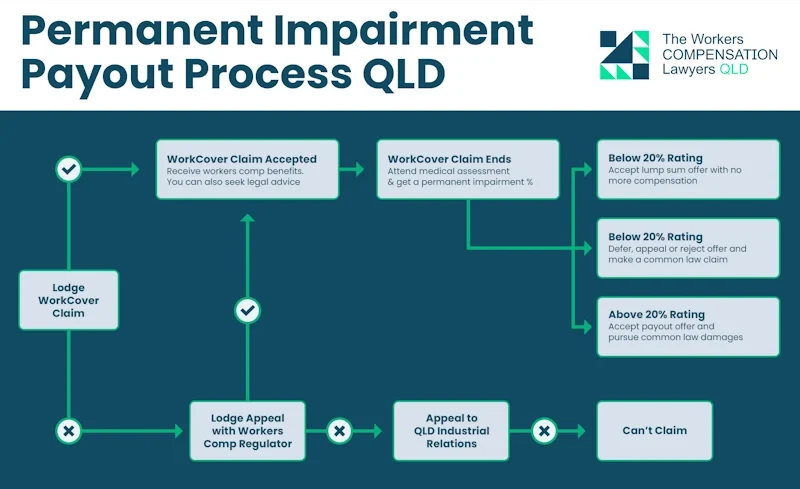
The 20% threshold is the DPI level that changes your legal position. Below it, accepting a statutory lump sum may limit what else you can claim. At 20% or above, common law pathways can open, depending on the circumstances.
That’s why it is the single most important number in the permanent impairment payout process in QLD.
You face a choice: accept the statutory lump sum and finalise the WorkCover claim, or reject it and consider other options.
Accepting the lump sum at this stage can limit what else you can pursue, so the headline permanent impairment payout isn’t the only factor to weigh up.
You may be able to accept the statutory lump sum and still pursue a WorkCover common law claim if employer fault can be established.
That significantly changes the financial picture because common law damages consider more factors, including lost earnings, pain and suffering, and future care costs, amounts no WorkCover payout calculator will show.
The real risk: A higher lump sum can look attractive on paper. But if accepting it closes off a common law pathway worth much more, the better-looking number is actually the worse decision.
That is why you should seek qualified legal advice before accepting a WorkCover lump sum offer. Call 1800 575 023
The biggest mistake is assuming every calculator gives the same answer. They don’t. Some calculators are:
The second mistake is treating the result as guaranteed. A calculator is only as good as the inputs. If the impairment percentage is wrong or the injury date is off, the answer can be miles off.
The third mistake is stopping at the compensation number. The more important question is what the offer means for the rest of your claim. On a permanent impairment matter, timing and election rights can be just as important as the payout itself.
If you have already received a notice of assessment, please take your time before making a decision. Read the DPI percentage, check the dollar amount against the current WorkCover payout table, and confirm whether the figure is being calculated under the correct financial year and rules.
Then ask three questions before you sign anything:
If something feels off, have someone review the paperwork before you commit. A small error in the DPI assessment can materially affect the permanent impairment payout figure in QLD. Be aware that once you make your choice, it cannot be reversed.
Physical and psychological injuries are assessed separately, and that difference matters when it comes to your permanent impairment payout amount in QLD.
Under Queensland workers’ compensation law, a psychological or psychiatric injury is assessed using the Psychiatric Impairment Rating Scale (PIRS) rather than the physical injury tables. The DPI percentage is still the output, and the same WorkCover payout table converts that percentage into a dollar figure. But getting to an accurate DPI for a psychological injury is significantly more complex.
Key point: If you have both a physical and psychological injury from the same workplace incident, you may be entitled to separate DPI assessments. The combined figure can move you into a higher permanent impairment payout bracket, including potentially above the 20% threshold.
For a full breakdown of how WorkCover handles mental health claims, see our guide to WorkCover psychological injury claims.
A few reasons the process is more contested for psychological injuries:
Most injured workers don’t ask this question until it is too late. A permanent impairment payout under the statutory scheme is a fixed lump sum tied to the WorkCover payout table. A common law damages claim is something else entirely.
The statutory lump sum covers permanent impairment only. It does not compensate you for:
For most workers, the statutory permanent impairment payout amount in QLD is the starting point of a final settlement, not the end of it.
To win a common law damages claim in Queensland, you must prove employer negligence caused your injury or illness. But when you succeed, compensation is typically higher than statutory payments.
That’s because “heads of damages” in a common law settlement can consider your:
Here’s the critical difference
Statutory Lump Sum | Common Law Damages | |
|---|---|---|
Based on | DPI percentage | Negligence plus financial loss |
Covers | Impairment only | Lost earnings, and suffering, medical care, past and future losses |
Available to | All eligible injured workers | Injured workers who can prove employer negligence |
Impacted by 20% threshold | Yes | Yes – threshold determines eligibility |
The real risk: Accepting a statutory permanent impairment payout below 20% DPI can close off your common law pathway entirely. If employer negligence contributed to your injury, that decision could cost you significantly more than the lump sum itself.
Our WorkCover common law claim payouts guide explains how damages are calculated and what you need to establish a viable claim. For a rough figure, our work injury damages claim calculator can give you a starting estimate based on your circumstances.
If your QLD permanent impairment payout amount feels wrong, it may be because the DPI rating itself is wrong. The assessment process isn’t infallible, and disputing an inaccurate rating is a legitimate, often worthwhile step.
You can challenge a DPI rating if you believe:
Even a 2-3 percentage point difference in a DPI assessment can translate to thousands of dollars in permanent impairment payout when mapped against the WorkCover payout table.
Near the 20% threshold, a disputed rating can be the difference between a statutory-only outcome and access to a common law claim.
The formal process for disputing a DPI rating in Queensland involves the following steps:
Do not wait. Timeframes for disputing a DPI rating are strict. If you have received a notice of assessment and believe the percentage is too low, get advice immediately. Delays in this process are rarely recoverable.
The difference between accepting a low DPI and successfully disputing it isn’t just a larger permanent impairment payout. It can also change your eligibility for common law damages entirely.
If you are unsure whether your rating is accurate, our free WorkCover claim review can help you get a second opinion.
Permanent impairment payouts in Queensland are based on your Degree of Permanent Impairment, or DPI, and the compensation rules that apply when the offer is made.
The higher your DPI, the higher the payout, but the final amount depends on the current statutory rates and the injury category.
There are online calculators that can estimate a Queensland WorkCover permanent impairment payout, but they are only as accurate as the details entered. Use them as a guide, then confirm the final figure against your notice of assessment and the current rates.
The WorkCover payout table shows the indicative lump sum amount for different DPI percentages. It helps injured workers see the rough dollar value of an impairment rating, but it does not replace the formal assessment or the current legal rules.
The 20% threshold matters because it can change your legal options.
Yes. Psychological injuries can be assessed for permanent impairment, but the process is usually more complex and often more contested than physical injuries. The DPI percentage still converts to a payout using the same statutory framework.
A statutory payout is a fixed lump sum based on your DPI, while a common law claim depends on proving employer negligence and can cover broader losses such as lost earnings, pain and suffering, and future care costs.
Yes. If you believe the rating is too low or based on the wrong information, you may be able to request a review and progress the dispute through the Queensland workers’ compensation process. Strict time limits apply, so act quickly.